


- Client: Goodwine
- Category: Restaurants and cafes, Shopping centers and stores
- Location: Kyiv, Mezhyhirska st., b. 82
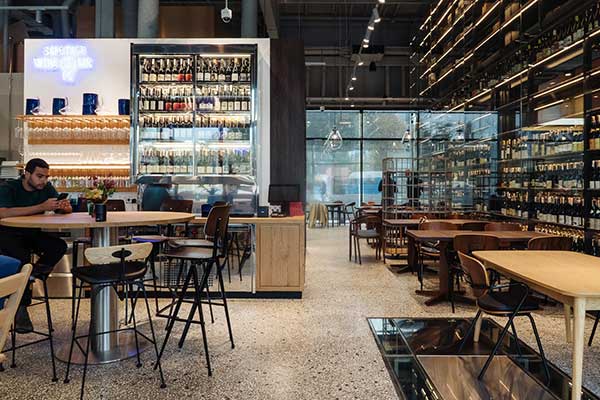
In the multifunctional complex of the gastro hub Garage from GOODWINE at 1500 m2 are included:
- bakery-cafe Bakehouseu
- Yellow Place coffee shop and roasting center
- wine bar and natural wine shop Sabotage Wineu
- Mirali restaurant
In a unique restaurant and shopping complex, the Termal company has completed unique, most energy-efficient ventilation systems, heating, air conditioning cooling of technological areas, smoke removal from baking equipment, heat transfer (recovery) systems from production areas to restaurant halls, automation of the entire climate, and smart home systems.”
The main heat source of the entire complex is Japanese heat pumps/VRF systems by Toshiba. Both classic 2-pipe and 3-pipe VRF systems were used to further save the building’s energy resources.
The three-pipe freon system makes it possible to divide the premises of the building into zones, and when cooling is required in the technological areas of the bakery or kitchen, the heat from these zones is transferred through the freon network to the halls of restaurants, entrance groups – wherever heat is needed. Since there is always a lot of waste heat in hot shops, bakeries, and restaurant kitchens, customer areas receive almost free heat for almost the entire heating period. During the heating period, the COP of such systems can be above 7 (from 1 kW of electricity consumed, we receive more than 7 kW of heat).
Toshiba’s VRF system also has maximum EER and SEER efficiency during the summer in air conditioning mode. Toshiba outdoor units are located on the roof of the building.
For additional comfort, Rosenberg designer thermal curtains of the ZEN G and 2VV ESSENSSE NEO series are installed in all entrance groups.
All ventilation units are equipped with the best REMAK HRZ recuperators with a heat recovery rate of up to 91%, high-efficiency RUCK ETALINE series fans, REMAK freon evaporators-condensers and Toshiba inverter compressor-condenser units. The ventilation equipment is mounted on a flat roof on frames. Automatic control cabinets made of Schneider Electric components, controllers with Dandoss MCX software are installed in the server room and connected to the central dispatching system of the building.
All exhaust air from the kitchen and bakery areas is first filtered and purified by a hydrofilter, then by G2 and G4 filters, and, if necessary, is recycled through the REMAK HRZ recuperator. If heat recovery is not required (for example, in summer), the exhaust air passes through the recuperator bypass and is discharged to the outside.
What was done
- analysis of an outdated project
- feasibility study for the use of modern systems
- design of HVAC and automation systems
- supply of all equipment
- installation work
- launching the system and setting up the HVAC
- setting up automation systems and integration into the central system




Stages of work
Pre-design work
An analysis of an outdated design solution based on chiller-fan coil equipment was carried out. The building reconstruction project was analyzed, and energy-efficient and cost-effective equipment was selected.
Design
The project of supply and exhaust ventilation (Ruck and Remak) with the function of cooling, air heating, 3-pipe VRF Toshiba air conditioning system was made. Many solutions for heat utilization, heat pumps and smart systems have been designed.
Preparatory work
Preliminary marking and planning, preparation of sites for ventilation machines, mounting frames and openings were carried out. The following works were performed: – drilling holes for air ducts, copper and drainage pipelines, electrical cables, installation of embedded parts.The first stage of installation works
The first stage of installation work
Air ducts, freon lines, Toshiba air handlers and heat recovery units, drainage pipes, as well as power lines and insulated ducts were installed. Equipment was delivered to the facility.
The second stage of installation work
A supply and exhaust machine with a recuperator, a freon evaporator and condenser, and a backup electric heater was mounted on the roof, on prepared frames. The supply and exhaust system was assembled. Heat pumps from the Toshiba Design Bureau were installed to heat and cool the supply air. A Toshiba VRF system was installed as the main heating and cooling system. Ducted indoor units were installed. A water filter was installed.
The third stage of installation work
Installation of supply and exhaust grilles and diffusers was completed. A ventilation system for the kitchen (kitchen umbrellas) was installed. Thermal curtains were installed for all groups.
Automation
Automation boards in the server room and wired consoles of the Toshiba VRF system were installed.
Commissioning and adjustment works
We set up the system, started it up, purged it, adjusted it, and prepared it for operation. Separate work was also carried out to set up an automation system for all climate control equipment and integrate it into the smart home management system.
Acceptance into operation
The facility was put into operation and the executive documentation was prepared. Trainings were held for the operating personnel.
Maintenance
To maintain the high efficiency and stability of the HVAC system, the company regularly carries out scheduled maintenance of climate control equipment in accordance with the regulations and at the additional request of the client.